
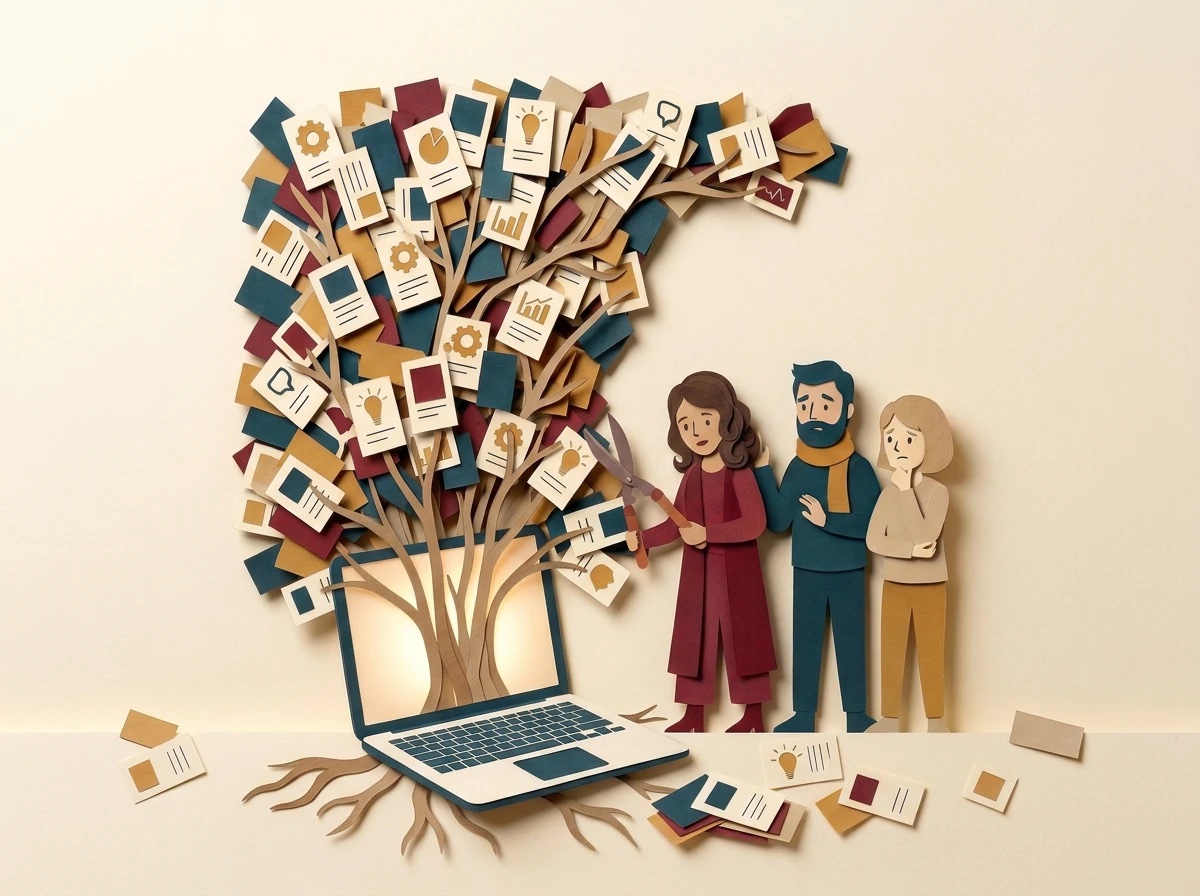
Anyone who works in an agency knows this scene. The presentation is just around the corner, the ideas are on the table, the team has to choose. And someone says: “Let’s ask the AI for a few more options, just in case.”
It sounds like a prudent move. A study published a few days ago suggests it is exactly the opposite.
The experiment
The paper is called Too Late to Prune: Generative AI, the Screen, and Team Creative Decisions, by Difang Huang, Shumin Yu, Fadong Chen and Weihua Zhou (arXiv, 10 October 2026).
The researchers involved 148 three-person teams in a product design task split into two timed stages: first searching for ideas, then selecting. Every team had the same language model for the same 15 minutes; only the when changed. The experiment was preregistered, meaning hypotheses and method were declared before any data was collected.
The results, in short:
- Moving those 15 minutes from the search stage to the selection stage lowered the creativity of the designs, as rated by experts, by 0.62 standard deviations. A clear difference, with similar usage: teams queried the model at much the same rate.
- Used early, AI multiplied the pool of ideas fivefold, and teams then pruned it, keeping the best.
- Used late, it did something else. Teams reached the moment of choice with few ideas, just like teams that never had AI, and at that point started searching again: 29% of their selection-stage queries went into generating new options, compared with 11% for teams that had AI throughout. They submitted 73% more proposals than teams without AI. More proposals, not better ones.
And there is a detail that struck me more than anything else: the designs were also scored by other language models. The AI judges recognised the benefit of having AI, but not the cost of using it at the wrong moment. The human experts did.
Why it happens
The paper’s title uses a gardener’s metaphor: prune. Every creative process involves two different jobs. The first is opening up: searching, exploring, multiplying the possibilities. The second is closing down: comparing, discarding, choosing. In projects we call them the divergent and convergent phases, and trouble starts when they get mixed up.
Generative AI makes options almost free. So the bottleneck is no longer finding ideas: it is choosing between them. If AI arrives while the team is still searching, its ideas compete with the team’s and go through the same filter. If it arrives when the team should be choosing, the new ideas skip the filter: they come in late, fresh, and nobody has time to weigh them properly against the others. The result is a wider range and a weaker decision.
It is what happens, with or without AI, every time a selection meeting turns into a new brainstorm.
Four thoughts, between research and experience
Reading the study, it felt natural to cross it with my own experience of working with creative teams. A few reflections came out of it.
1. Let AI widen the field, when you are exploring. In the search phase it is an extraordinary accelerator: in a few minutes it brings sparks, variants and points of view that would take a team hours. That is where it does its best work, when its ideas can compete with ours and go through the same filter.
2. Use it to put ideas to the test, when you are choosing. In the selection phase its role changes: it can help us challenge the ideas we have put on the table. You can ask it to check each proposal against the brief and the objectives, to play devil’s advocate, to look for weak points, to anticipate the client’s objections. An awkward conversation partner, and useful precisely for that reason.
3. Recognise when the moment to choose has come. It is one of the most delicate steps, both for the team and for whoever leads it. Choosing is a little frightening: on the horizon there is always one more idea, which seems more interesting, more promising. That moment has to be recognised, and then protected. You gather the options and focus on comparing them. This doesn’t mean closing the door to continuous improvement: it simply has to happen transparently and deliberately. If a new idea that seems better turns up right then, you don’t let it barge in on a wave of enthusiasm. It pays to learn to ask: is it really worth reopening everything? Are the options we have really weaker? Will we have time to explore and validate it as we did the others? If the answer is yes, you reopen the search, and you tell everyone. If it is no, you go back to choosing.
4. Don’t let AI judge work made with AI. If models can’t see the cost of a flawed process, the final assessment must stay with people who know the context, the client and the problem.
Behind all four lies the same idea: AI isn’t a tool to bolt onto the work as it is, but one to bring into harmony with how a team explores, chooses and decides. If the process isn’t clear, AI risks producing a lot of content and little value.
That is why somebody has to design the process: deciding when a tool comes in, protecting the moment of choice, saying “no more options now” when it is needed. That is the job of whoever leads a team, whether they are called project manager, creative director or facilitator.
The caveats
In fairness, the study’s limits.
- It is a preprint: it has not yet been reviewed by other researchers.
- It is a controlled experiment, with a short product design task and tight timing. A real project lasts weeks, and involves clients, budgets and people who change their minds.
- It is a single study. The result is solid within its scope and consistent with what we know about divergent and convergent thinking, but it is not a law.
That said, it confirms something I have seen in teams since long before AI arrived: the best ideas don’t simply come from having more options, but from knowing how to choose the right ones. At the right moment.
The research
Difang Huang, Shumin Yu, Fadong Chen, Weihua Zhou, Too Late to Prune: Generative AI, the Screen, and Team Creative Decisions, preprint, 10 October 2026.
arXiv page · PDF
Further reading
- Method and imagination: how to solve a problem, on the difference between divergent and convergent phases.
- Creative pitches and presentations, on organising creative work when time is short.